


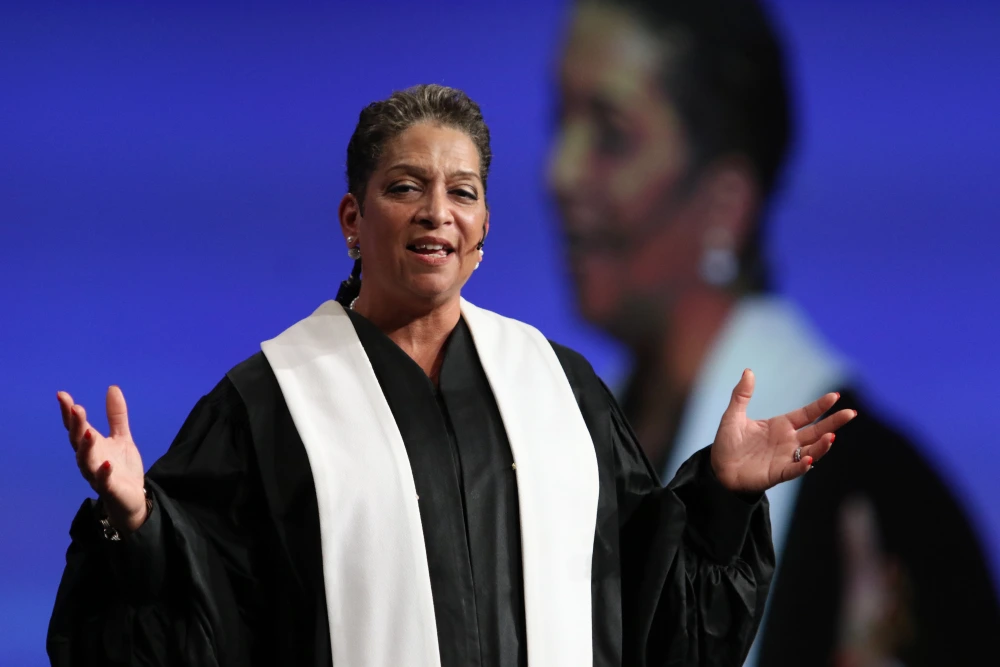
For decades, some of the largest Baptist bodies in America have pointed to scripture — 1 Timothy 2:12-14, 1 Corinthians 14:34-35 — to justify keeping women out of the pulpit. Paul’s instruction that women “keep silent in the churches” and not “exercise authority over a man” has been treated, in these traditions, as a fixed rule rather than a first-century pastoral letter open to interpretation. Meanwhile, the same institutions that police women’s speech have struggled for years to police predators in their own ranks.
That contrast is the center of a debate now playing out publicly within the Southern Baptist Convention (SBC), the nation’s largest Protestant denomination, and it raises an uncomfortable question for critics: an organization can be strict about who is allowed to preach, while being lax about who is allowed to abuse.
Tightening the Rules on Women
In June 2026, messengers at the SBC’s Annual Meeting in Orlando voted 74.6% in favor of advancing the “Truth and Unity Amendment,” a constitutional change that would bar any church employing a woman in a pastoral role from remaining in the convention. The language goes further than earlier SBC policy, which mainly targeted the title “pastor.” The 2026 version prohibits women from performing the function of a pastor, elder, or overseer — including preaching to a full congregation. Because SBC bylaws require constitutional amendments to pass in two consecutive years, the measure needs a second vote at the 2027 Annual Meeting in Indianapolis before it is permanently codified. If it passes again, congregations with women pastors face expulsion — a fate that already befell California’s Saddleback Church, removed in recent years for ordaining a woman.
Critics argue this is a denomination doubling down on exclusion at the exact moment its credibility on protecting the vulnerable is under fire.
A Slower Reckoning With Abuse
In 2022, the SBC received the Guidepost Solutions report — nearly 300 pages documenting two decades in which top leaders in the convention downplayed abuse reports, sidelined survivors, and shelved reform recommendations. Investigators, who interviewed 330 people and reviewed roughly five terabytes of records, found the convention’s own law firm had repeatedly counseled leaders not to act when abuse concerns were raised. The report also detailed a credible allegation against a former SBC president and revealed that senior staff had quietly kept a list of hundreds of accused ministers for years without acting on it.
That report followed a 2019 investigation by the Houston Chronicle and San Antonio Express-News, which had already found roughly 380 Southern Baptist church leaders and volunteers facing abuse allegations since the late 1990s, with more than 700 victims — many of them children. The SBC’s decentralized structure, in which individual churches ordain and hire their own staff with no shared personnel database, made it easy for credibly accused men to move quietly from one congregation to the next.
The 2022 convention voted to apologize to survivors by name and authorized reforms, including an offender database. It looked, at the time, like the start of genuine change.
The Walk-Back
Four years later, that reckoning is being publicly rolled back by some of the same institution’s leaders. The SBC’s newly elected president has called the Guidepost report a “snipe hunt” and said the abuse issue has been “weaponized” politically. A former SBC president went further, calling the entire investigation a “reckless hoax.” Survivors and advocates say this shift — treating abuse as an overblown controversy rather than a documented pattern — has become increasingly mainstream within convention leadership rather than a fringe position, even as the same body moves to tighten restrictions on women in ministry.
For critics, the juxtaposition is the whole argument: a denomination that found the institutional will to advance a strict, multi-year constitutional process to keep women out of pastoral roles, while treating a documented, independently investigated abuse crisis as a matter better minimized than confronted. The theology cited to silence women is treated as non-negotiable; the moral obligation to protect children and survivors is treated as up for debate.
Not a Monolith
It’s worth noting that “Baptist” is not one institution, and the picture is not uniform. The historically Black National Baptist Convention, USA (NBCUSA) has moved in the opposite direction under President Dr. Boise Kimber, appointing Rev. Dr. Valerie Thompson as Chief of Staff, naming Rev. Debbie Strickling-Bullock the first woman to chair the Sunday School Publishing Board, and featuring Rev. Tracey L. Brown as the first woman to preach an evening service in the convention’s 145-year history. The Progressive National Baptist Convention and groups like Baptist Women in Ministry have long ordained women and advocated for full inclusion, arguing their reading of scripture — pointing to Acts 2:17-18, where Peter describes the Spirit poured out on “sons and daughters” alike, or the women at the empty tomb in Matthew 28 who are the first to carry the resurrection message — supports women in pulpit leadership rather than forbidding it.
The Other Side of the Argument
Defenders of complementarian theology would object to the framing of this piece on a few grounds worth stating plainly. They argue that restricting the pastoral office to men is a matter of theological conviction rooted in their reading of Paul’s letters, not a judgment about women’s worth or capability, and that plenty of women in these same denominations hold significant, well-regarded ministry roles outside the pastorate. They would also reject the implication that the two issues are causally linked — that a complementarian view of church office somehow produces or excuses abuse — and would point out that clergy sexual abuse is a documented problem across denominations, including ones that ordain women, the Catholic Church being the most prominent example. Skeptics of the “crisis” framing, including current SBC leadership, argue that roughly 380 credible cases across a denomination of tens of thousands of churches and millions of members, while serious, doesn’t establish a systemic pattern of institutional protection of predators — a claim survivors and the Guidepost investigators dispute based on what they found in internal records.
Whether those defenses hold up is something readers will weigh differently depending on their own theology and their read of the evidence. What isn’t in dispute is the documentary record: the Guidepost report’s findings, the 2019 newspaper investigation, and the 2026 vote to tighten restrictions on women are all a matter of public record, now sitting side by side.






Leave a Reply