
Eufaula, Alabama
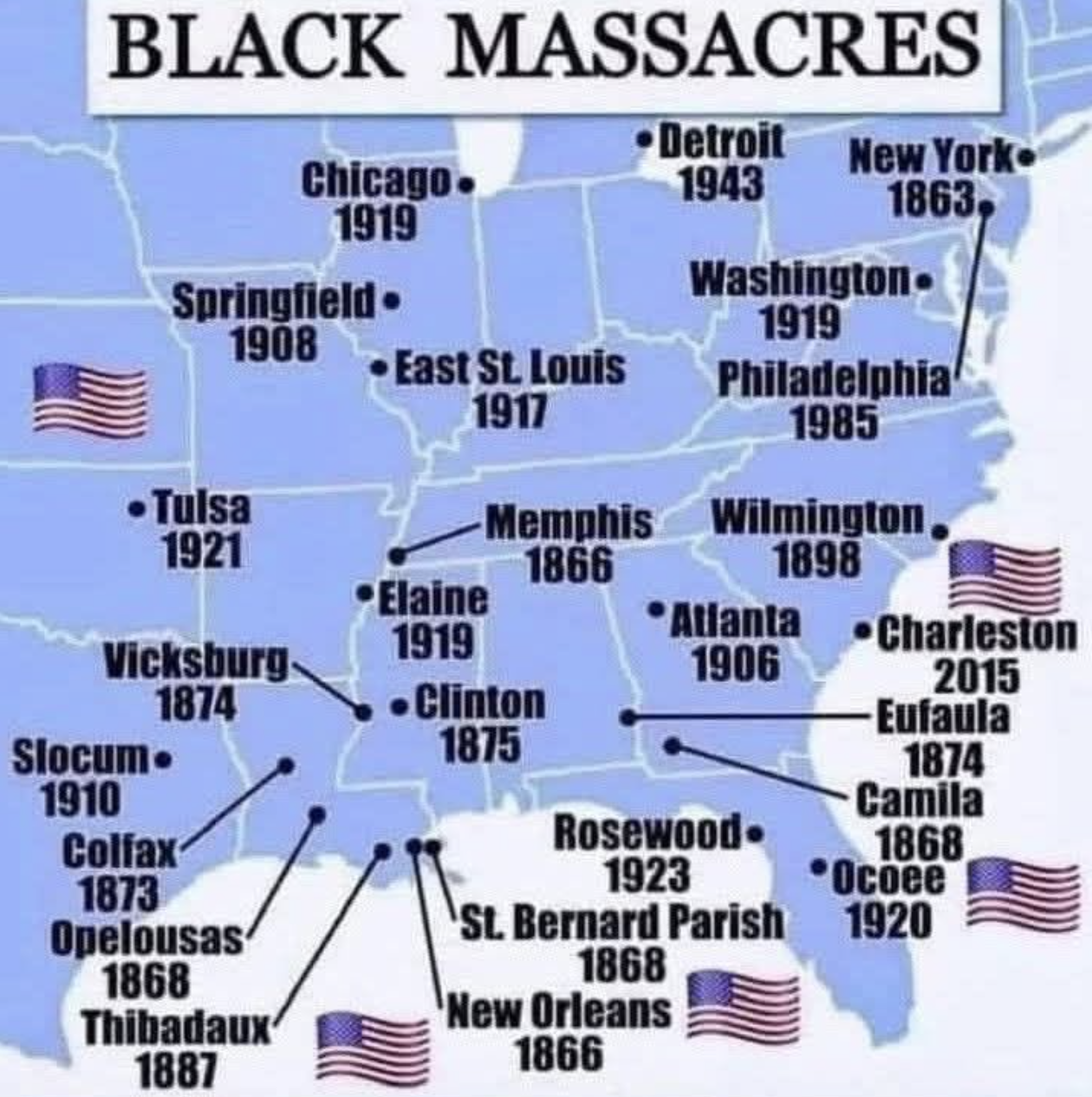
During the Civil War, Eufaula, Alabama, was at once a Confederate stronghold, the commercial center of Barbour County, and home to more Black people than white. After Emancipation, ratification of the Fifteenth Amendment guaranteed voting rights for Black men. This empowered Barbour County’s new Black electorate to end white supremacist officials’ control over the county. In 1870, Black voters helped elect Elias Keils, a white candidate who supported the aims of Reconstruction, to the position of City Court Judge.1 Four years later, when Keils ran for re-election, local white residents determined to regain political dominance in the county used terror and intimidation to suppress Black votes, ultimately waging a deadly massacre that left dozens of Black people dead.2
As the 1874 election neared, white employers openly fired any Black workers who intended to vote for Keils.3 False rumors spread that Black residents planned to violently drive white voters from the polls, and white residents began stockpiling guns near Eufaula polling sites.4 Seeing the threat of election day violence, Keils tried to notify state and federal officials of the danger, but Alabama’s Attorney General rebuffed the warning and A.S. Daggett, captain of federal troops stationed in Eufaula, claimed it would violate his orders to use federal soldiers to protect Black voters.5
Despite the risk, hundreds of African Americans marched to the downtown Eufaula polling site on November 3. Some were immediately arrested and jailed on fraud accusations.6 Around noon, several white men forced a Black man into an alley and threatened to arrest him if he did not vote against civil rights. Black witnesses protested and a pistol was fired—white people claimed a Black man had fired a shot at them while many Black people insisted a white man had fired a shot into the air. Soon afterward, a large mob of white men retrieved stockpiled guns stored nearby, gathered in the street and in the upstairs windows of surrounding buildings, and fired “indiscriminately” into the crowd of mostly unarmed Black voters.7
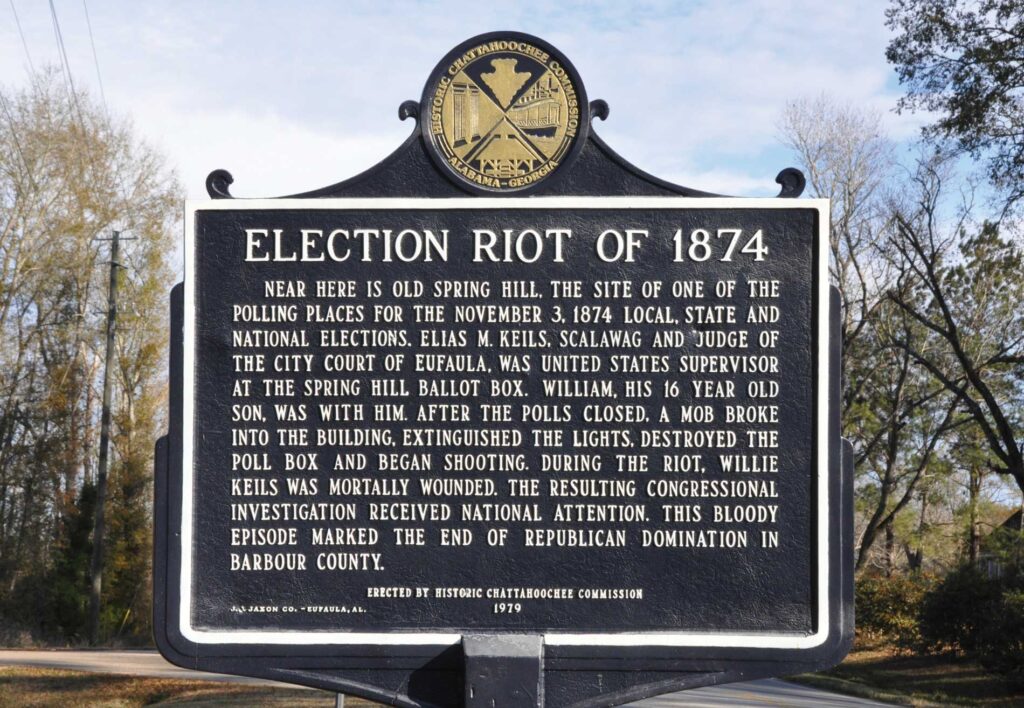
A historical marker in Barbour County, Alabama, erected in 1979, describes the 1874 Eufaula Massacre as a “riot.”
Jonathan Gibson
Within minutes, 400 shots had been fired, leaving at least six Black people dead and injuring as many as 80 people.8 Many survivors fled, including an estimated 500 Black people who had not yet voted.9 One Black man who survived later recalled that, when the shooting stopped, he heard the white crowd cheer, “Hurrah for the white man’s party.”10 Later that day, a white mob attacked another county polling station in Spring Hill, Alabama, where Keils was the election supervisor. The mob destroyed the ballot box, burned the ballots inside, and killed Keils’s teenage son.11
Newspapers described the violence as a “riot,” but a Congressional representative later characterized the attack as a massacre.12 Sentiments published in the local white press praised the attack: “Big riot today. Several killed and many other hurt—some badly—but none of our friends among them. The white man’s goose hangs high. Three cheers from Eufaula.”13 Although the identities of many white perpetrators of the massacre were known, no white person was ever convicted. Instead, a Black man named Hilliard Miles was convicted and imprisoned for perjury after identifying members of the white mob.14 Decades later, Braxton Bragg Comer, whom Mr. Miles had named as a perpetrator of the massacre, was elected governor of Alabama.15
The Eufaula Masssacre and its aftermath showed Black residents that exercising their new legal rights—particularly by voting—made them targets for deadly attacks and they could not depend on authorities for protection.16 The result was mass voter suppression. While 1,200 Black Eufaula residents voted in the 1874 election, only 10 cast ballots in 1876. That legacy remains.17 Today, the population of Barbour County is nearly 50 percent Black but white officials hold 8 of 12 elected county positions. In 2016, the county had the highest voter purge rate in the United States.18
During Reconstruction, Black voters lost their lives in Eufaula and many more were disenfranchised because they supported pro-Reconstruction Republican candidates who pushed for Black citizenship rights at a time when white supremacy dominated the Southern Democratic party. This division would continue until major party realignments during the 20th century civil rights movement. Today, public memory of Reconstruction violence in Barbour County is reduced to one historical marker erected in 1979, which describes the “Election Riot of 1874” as a “bloody episode that marked the end of Republican domination in Barbour County.” In downtown Eufaula, the streets where Black voters were shot down for voting more than 140 years ago now host a towering Confederate monument erected by the United Daughters of the Confederacy in 1904. S.H. Dent, a former Confederate soldier who witnessed and possibly helped commit the massacre, spoke at the monument’s unveiling.19
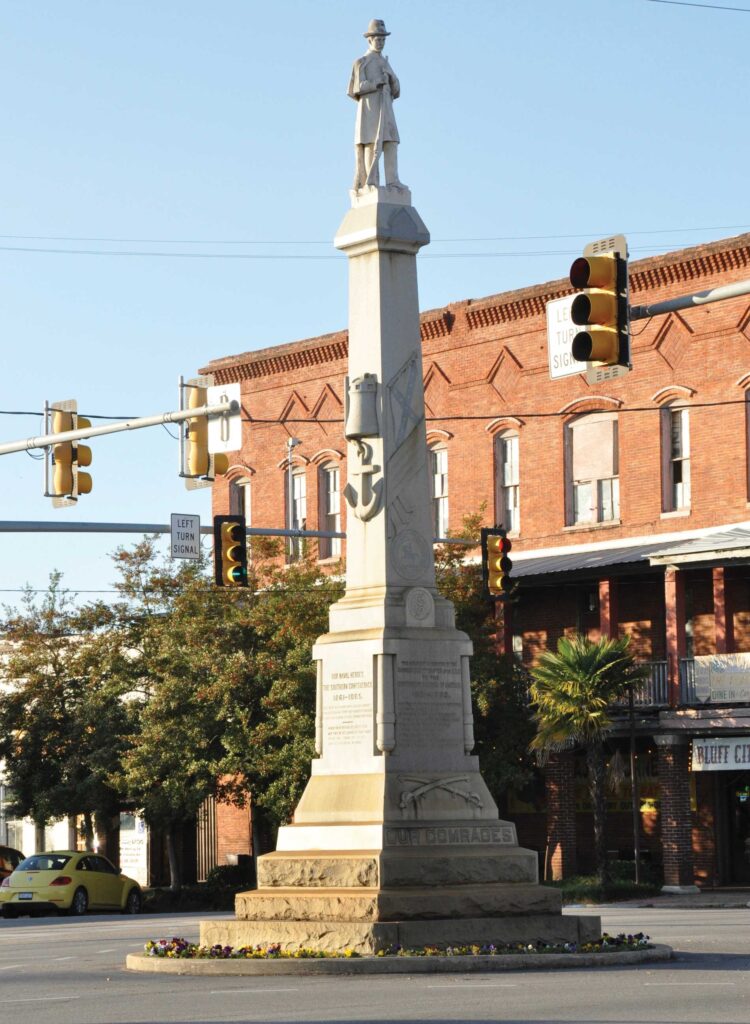
In Eufaula today, a Confederate monument stands in the same area where Black voters were massacred in 1874.
Jonathan Gibson